
What Kind of Companion Am I?
Tadabbur Newsletter Issue 05 - September 2026
بِسْمِ ٱللَّٰهِ ٱلرَّحْمَٰنِ ٱلرَّحِيمِ
Editor’s note
Salaam, fellow ponderers!
Over the last few years, “community” has become a byword for our generation’s quest for offline connection. In London, we’ve been blessed with numerous collectives popping up: run clubs, social mixers and reading groups, like Tadabbur Club! Within these circles, one question keeps popping up: what does it truly mean to be in community with one another?
So, as we do around here, we turned to our book of guidance in search of answers. From dissecting shahīh al-nafs to looking at Zeus’ Law through an Islamic lens, this newsletter edition has lots of gems, so grab a cuppa and enjoy the read!
Finally, for those who journal, we’ve also included a reflective prompt towards the end and would love to hear your thoughts! If you’d like to share a response, keep an eye on our Instagram page to answer our call out.
Introduction
What does it mean to partake in community?
In September, we turned to Surah Al-Hashr – The Gathering – to explore the idea of suhba (companionship).
Revealed in the context of Banu Nadir’s exile from Medina (a Jewish tribe), the surah turns a historical event into Islamic tenets that continue to resonate today, including: community, generosity, solidarity and tawakkul (complete trust and reliance upon Allah). Not many of us had studied the surah before, so we were grateful to do so amongst our own companions.
We delved further into this question – and other overarching themes in Surah al-Hashr – in our follow-up Deep Dive session, led by Dr Aaminah Patel.
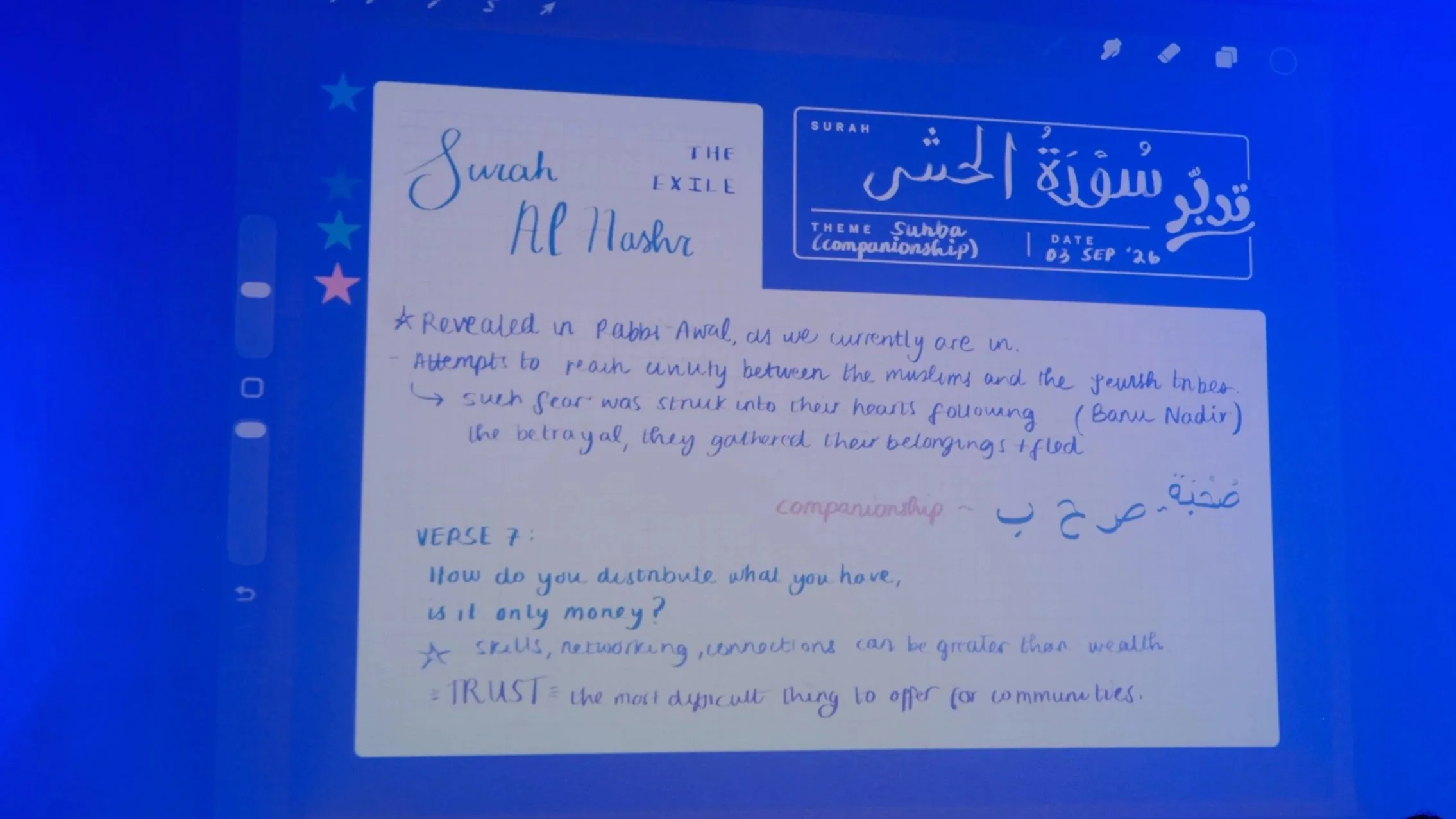
Quran Club
For the Quran Club, our facilitators chose suhba to probe one of the big questions of our time: how do we build bonds and communities in an increasingly disconnected age? Through reading this surah, we considered what the Quran teaches us about how believers are meant to relate to one another, and about the inner diseases that can prevent us from building genuine community.
But before getting into some of our reflections from the session, let’s unpack the word suhba itself.
What is suhba?
Suhba comes from the Arabic triliteral root ص ح ب (ṣa ḥa ba), which can mean “to accompany,” “to keep company with” and “to associate with.” The root occurs throughout the Quran 97 times in several forms, including:
صُحْبَة (suhba): companionship or the act of keeping company.
صَحِبَ (sahiba): to accompany, keep company with, or be alongside someone.
صَاحِب (sāhib): a companion or one who is closely associated with something. Its plural includes Sahābah (صَحَابَة), the historic term used for the close companions of the Prophet ﷺ.
Unlike words that might describe an acquaintance or temporary connection, the root of suhba implies true companionship.
With that in mind, here are two of my main takeaways from our session.
1. Community requires radical generosity
Many of us recently watched Christopher Nolan’s The Odyssey, which lays out the concept of Zeus’ Law, or xenia in Homer’s original poems – hear me out, there is a link here!
According to Greek mythology, xenia was an ancient moral code built around hospitality. It carried the expectation that strangers should be welcomed, fed, sheltered and treated with dignity, and that guests in turn would honour and respect their hosts.
We were struck by the parallels between xenia and our own tradition, particularly in the relationship between the Ansar (the helpers, from Medina) and the Muhajirun (the migrants, from Mecca).
وَٱلَّذِينَ تَبَوَّءُو ٱلدَّارَ وَٱلْإِيمَـٰنَ مِن قَبْلِهِمْ يُحِبُّونَ مَنْ هَاجَرَ إِلَيْهِمْ وَلَا يَجِدُونَ فِى صُدُورِهِمْ حَاجَةًۭ مِّمَّآ أُوتُوا۟ وَيُؤْثِرُونَ عَلَىٰٓ أَنفُسِهِمْ وَلَوْ كَانَ بِهِمْ خَصَاصَةٌۭ ۚ وَمَن يُوقَ شُحَّ نَفْسِهِۦ فَأُو۟لَـٰٓئِكَ هُمُ ٱلْمُفْلِحُونَ
59:9: As for those who had settled in the city and embraced the faith before the arrival of the emigrants, they love whoever immigrates to them, never having a desire in their hearts for whatever of the gains is given to the emigrants. They give preference to others over themselves even though they themselves are in need. And whoever is protected from the selfishness of their own souls — it is they who are truly successful.
Following the hijra (migration), the Prophet ﷺ paired each of the Muhajirun with an individual from the Ansar. What makes the Ansar so remarkable is not simply that they welcomed the newcomers, but how they welcomed them:
They did not simply tolerate those who had arrived, they loved them.
They did not compare themselves to the newcomers or resent what they had been given.
They gave preference to others over themselves, even when they were in need.
This ayah reveals another dimension to this generosity. While it benefitted the Muhajirun, it also protected the Ansar from their shahīh al-nafs.
Definition: Shahīh al-nafs
Shahīh al-nafs is referenced in ayah 9 in the form of شُحَّ نَفْسِهِ [shuhha nafsihi]. The Arabic triliteral root of ‘shuhha’ is ش–ح–ح which carries connotations of greed, stinginess, or miserliness. When it is used with the word ‘nafs’ (soul) it describes the greed, stinginess or possessiveness that can fester within the soul and prevent us from sharing what we have – the idea of “selfishness of the soul”. Whilst the Ansar and the Muhajirun were placed in circumstances that could easily tempt selfish behaviour — hoarding wealth, property, spoils of victory — this surah praises their actions because they conquer their shahīh al-nafs. They are humble, generous and act with restraint. We can see that this story is not only a military victory, but a moral victory over self-centeredness too.
In other words our generosity enriches us just as much as the recipient. When we give to others, we are not simply doing something for them. We are also repairing our own nafs (ego), and moving ourselves towards the kind of true success that Allah describes. The generosity of the Ansar helped create a longlasting spiritual and social bond between two groups of strangers, breaking tribal divisions and turning them into companions through faith. Suhba, then, can be a means for us to know one another.
Applying this to our own lives, we reflected on both what we give (our time, attention, energy and immaterial skills) and how we give (with intention, dignity and generosity of spirit).
2. A lack of true understanding can lead to hypocrisy
The surah then presents two starkly different approaches to community. The Ansar demonstrate love, generosity and solidarity. Contrastingly, the hypocrites lack integrity and make disingenuous promises. They are unwilling to stand alongside others if it comes at a personal cost.
لَئِنْ أُخْرِجُوا۟ لَا يَخْرُجُونَ مَعَهُمْ وَلَئِن قُوتِلُوا۟ لَا يَنصُرُونَهُمْ وَلَئِن نَّصَرُوهُمْ لَيُوَلُّنَّ ٱلْأَدْبَـٰرَ ثُمَّ لَا يُنصَرُونَ
59:12: Indeed, if they are expelled, the hypocrites will never leave with them. And if they are fought against, the hypocrites will never help them. And even if the hypocrites did so, they would certainly flee, then the disbelievers would be left with no help.
Allah gives us an insight into why:
لَأَنتُمْ أَشَدُّ رَهْبَةًۭ فِى صُدُورِهِم مِّنَ ٱللَّهِ ۚ ذَٰلِكَ بِأَنَّهُمْ قَوْمٌۭ لَّا يَفْقَهُونَ
59:13: Fear of you [believers] is more intense in their hearts than fear of God because they are people devoid of understanding.
The hypocrites’ fear of the believers is greater than their fear of Allah, because they do not understand His magnitude.
We reflected on what this might mean for us. When we lose sight of Allah and de-centre our imaan (faith), our actions can become driven by fear, self-preservation or reputation.
Instead of holding ourselves accountable in the eyes of Allah and each other, we risk slipping into individualism, making promises we cannot keep, and stepping away when solidarity becomes difficult.
This compelled us to look inward and consider: What values are driving the way we engage with our communities? Are our actions rooted in the purpose and values we claim to share?
Being in a community asks something of us, and it’s meant to. It asks us to give openly, show up for others with care, trust and dignity - not only when it is convenient, but especially when it costs us something. My hope is that we can carry these lessons with us into this community that we are building.

Deep Dive
Plurality of thought in Islam
We spent our Deep Dive session, led by Dr Aaminah Patel, dissecting some of the broader themes in Surah Al-Hashr – including the value of critical thinking and individual conscience when the Muslims are confronted by a moral conundrum.
Let’s break this down.
One of the most pivotal moments of the surah lies in the story relayed through ayah 5 – known as, “The Palm Trees:”
مَا قَطَعْتُم مِّن لِّينَةٍ أَوْ تَرَكْتُمُوهَا قَآئِمَةً عَلَىٰٓ أُصُولِهَا فَبِإِذْنِ ٱللَّهِ وَلِيُخْزِىَ ٱلْفَـٰسِقِينَ
59:5: Whatever you [believers] may have done to [their] palm trees – cutting them down or leaving them standing on their roots – was done by God’s leave, so that He might disgrace those who defied Him.
When the Muslims besieged Banu Nadir's fortresses they noticed a ring of palm trees around their homes. The canopy provided cover for Banu Nadir, allowing forces to attack the Muslims from a hidden position and preventing the latter from efficiently retaliating. Subsequently, some of the palms were cut down.
While scholars have offered different interpretations as to why the trees were felled – either to frighten Banu Nadir or remove their tactical military cover – there is little doubt that the act itself elicited different opinions amongst the Muslims. Some believed that destroying trees, especially in the name of warfare, could be equated to corrupting the earth. For others, it was justified under the circumstances of the siege.
Either way, the second and third parts of the ayah reveal how both stances – “cutting them (the palm trees) down or leaving them standing,” – were carried out “by God’s leave,” and therefore acceptable to Him.
As our conversation evolved, we considered how plurality of thought could be valuable for our ummah today – and what form that might take. For me, one of the most unexpected blessings of the past year-and-a-half has been meeting folks who are new to Islam – including at Tadabbur Club, Ramadan Space and other God-centered collectives.
By graciously telling me about their own faith journeys, each person opened my eyes to the diverse perspectives that collectively illuminate our ummah. Our different backgrounds inform how we see the world and approach worship – united by our spiritual goal of becoming closer to Him. That spectrum typifies how plurality of thought can encourage harmony in Islam.
Journal prompt: how can we overcome our shahīh al-nafs?
Reflecting on the characteristics of the Ansar, what is one way you will show up in your own communities over the next month that acts against your own shahīh al-nafs?
If you’d like to share your response with us, keep an eye on our Instagram page to answer our call out.
Community Reflections
“The Ansar had complete confidence in the vision of the Prophet ﷺ. If we are God conscious, every visceral act means more. Everything that is good in our lives not tethered to the dunya, but his ni’mah (blessings).”
-
“If we forget Allah in our day-to-day, we will be in constant pursuit of the temporary pleasures of this world with no guiding morality, and therefore no satisfaction at the end. It can be easy to do this when you’re in an environment that doesn’t remind you of Allah. Instead, we should try to live as the Ansar did. Their group configuration didn’t push them into heedlessness; they did not forget Allah and so conquered their nafs.”
-
“The Ansar had a shared sense of purpose which allowed them to stand firm in their collective faith. As such, every action they undertook became a profound act of worship by centering their lives upon Allah.”
To conclude…
Are you enjoying the Tadabbur newsletter? As a platform run by and for our community, we want to hear from you. If you have any ideas on how we can shape Tadabbur moving forward, feel free to get in touch over email or Instagram.
We’ll return for our next Quran Club on 5th November, inshaAllah. Set your reminder for ticket release at 7PM on 22nd October. We hope to see you soon!
O Allah,
Ar-Rahman (The Most Merciful), adorn us with the kindness and compassion to honour Your mercy in our relationships with others.
Al-Salam (The source of Peace), give us peace of mind and soothe our hearts when we feel emotional or physical pain.
Al-Aziz (The Almighty), empower us with the courage and moral clarity to face hardships knowing that true power belongs only to You.
Al-Aleem (The All-Knowing), inspire self-awareness in us, so we have the humility to reflect and know ourselves..
Al-Hakim (The Wise) if our paths change and we feel uncertain, enact your divine wisdom – reminding us that Your timeline is the only one that matters.
Ameen
Co-authored by Anjum and Sana | Co-edited by Anas and Sana
DISCLAIMER: Tadabbur Club is a UK-based, volunteer-run community seeking to deepen our connection with the holy Qur’an. We are not a scholar-led organization. Here are some educational resources you could use to further your journey: How to Get Closer to Allah: Exploring the Sequence of Allah's Names in Surah Al-Hashr, by Jinan Yousef, Yaqeen Institute for Islamic Research
