
Rizq & The Illusion Of Wealth
Tadabbur Newsletter Issue 02 - June 2026
بِسْمِ ٱللَّٰهِ ٱلرَّحْمَٰنِ ٱلرَّحِيمِ
Editor’s note: This month, we launched a brand new programme called Deep Dive. At Deep Dive sessions, we open our Qurans on the surah we covered at the Quran Club, but this time with the aim to delve even deeper into the surah in a class room setting with a teacher. Our Deep Dive classes for this year are led by Dr Aaminah Patel, a lecturer at Cambridge Muslim College. We started Deep Dive for the eager learners in our community who appreciate the reflective nature of Quran Clubs, and want to take it a step further under the guidance of a scholar.
This month at our Quran Club, we discussed the theme of rizq (provision) in Surat Al Hadid, which we explored in more detail in the Deep Dive session. Excitingly, Dr Aaminah contributed to the Deep Dive section of this blogpost based on her research for the session that she led.
QURAN CLUB
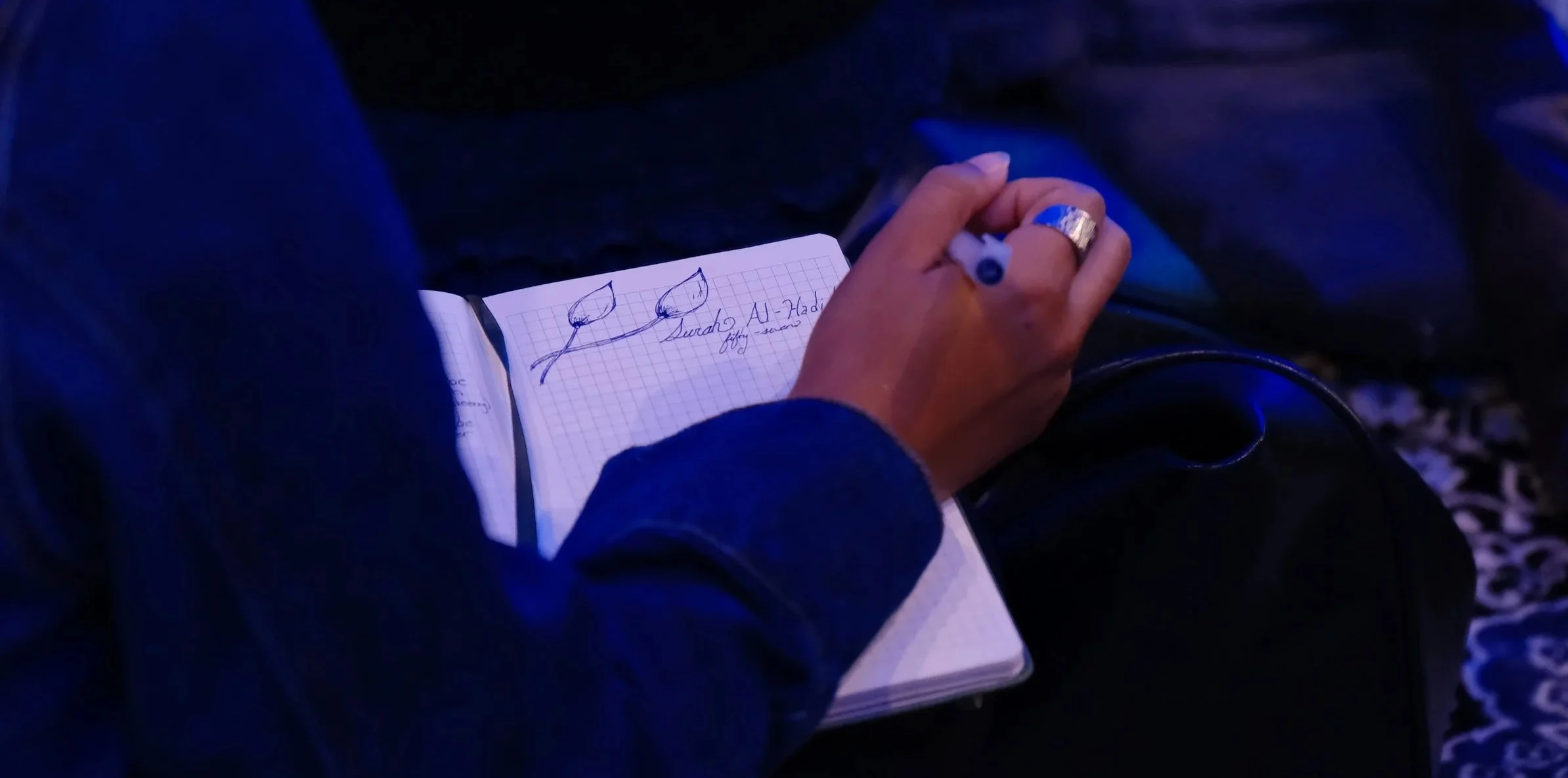
At our June Quran club we reflected on Surat Al Hadid, The Iron. This is a Medinan surah, revealed to the early Muslim community as a call for detachment from things of the dunya, and to warn away from clinging on to wealth.
Our conversations began with the question of what rizq really is. Within the room there were answers of “sustenance”, “provisions” and “blessings”. These answers were punctuated with deeply personal reflections from the room, with vulnerability that allowed us to analyse the subjective nature of provision, and the individual blessings we have each been provided with.
Entrusted, not owned
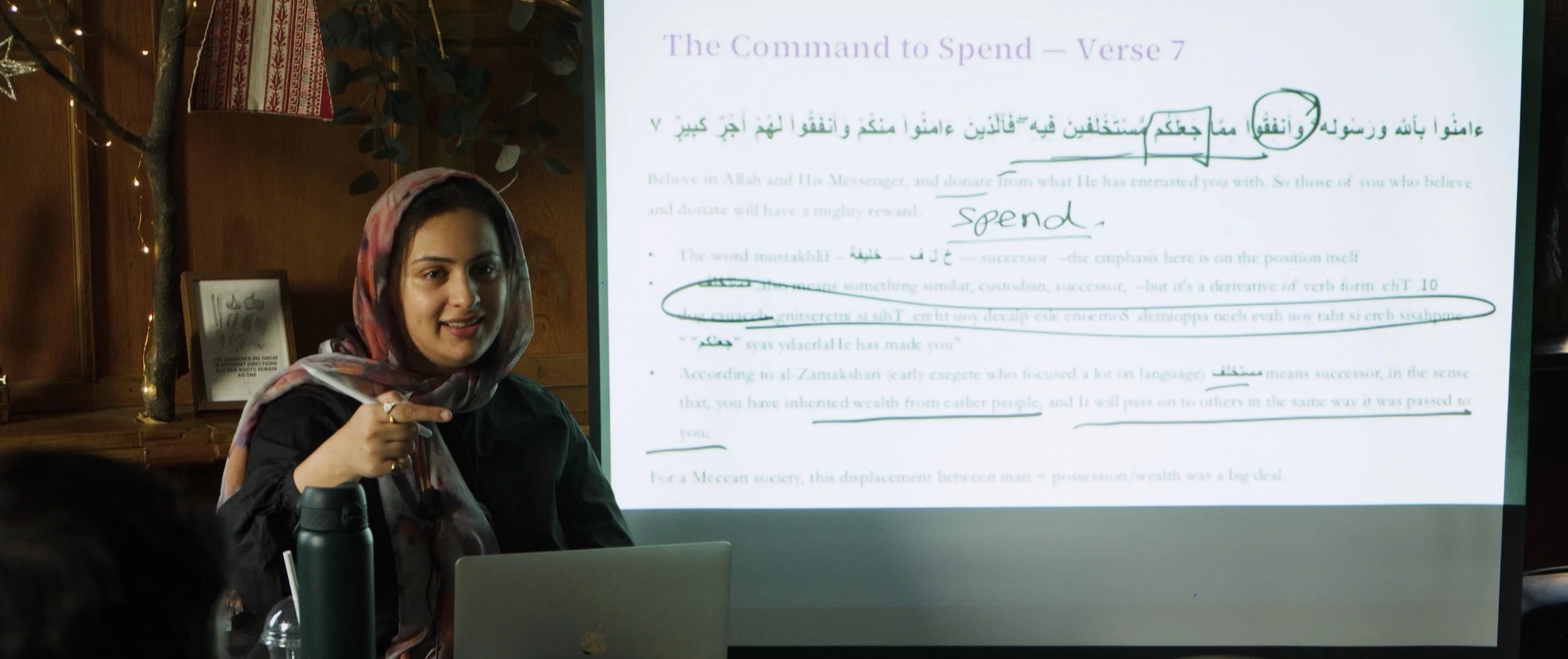
With these initial reflections in mind, we turned to ayah 7 of the surah, which provided us with a clear reminder that Allah alone has entrusted us with our provisions. Nothing truly belongs to us, but rather we are mustakhlafeen – trustees, or stewards. To be a trustee implies a responsibility, a promise or a role to be played. Allah tells us that role within the same ayah: to donate our rizq and to spend it on others as well as ourselves.
ءَامِنُوا۟ بِٱللَّهِ وَرَسُولِهِۦ وَأَنفِقُوا۟ مِمَّا جَعَلَكُم مُّسْتَخْلَفِينَ فِيهِ ۖ فَٱلَّذِينَ ءَامَنُوا۟ مِنكُمْ وَأَنفَقُوا۟ لَهُمْ أَجْرٌۭ كَبِيرٌۭ
57:7: Believe in Allah and His Messenger, and donate from what He has entrusted you with. So those of you who believe and donate will have a mighty reward.
To be a trustee implies a responsibility, a promise or a role to be played. Allah tells us that role within the same ayah: to donate our rizq and to spend it on others as well as ourselves. This led us to the question of: if rizq is never ours to begin with, how does it change our relationship with wealth?
“Rizqun min Allah” – a reflection from the facilitator
‘Rizqun min Allah’ [provision is from Allah] is an oft-mentioned saying, so let’s delve deeper into what it means for rizq to belong to Allah and relinquish the concept of ownership. Allah uses the word مُّسۡتَخۡلَفِینَ (successors, trustees, or inheritors) to describe our relationship with wealth and provision in Surat Al-Hadid [57:7]. We have been entrusted with all of our provision by Allah, to act as His representatives and spend in His way within His rules. It is for this reason we should give freely, and act with the knowledge that our provision will never come from anyone but Allah. We live in a time of uncertainty, trying to secure our livelihoods whilst surrounded by scarcity. Reframing our relationship with wealth as something that never truly belonged to us reminds us that as long as we act within Allah’s rules, we can fully trust Him with all of our provision. A job loss, an unexpected bill, an eviction notice - all of these happen by Allah’s hand and we should not despair in His ability to provide for us from unexpected sources. Whatever we lost was never ours to begin with, to live with this in mind is to live daily for His sake and at peace with His plan for us.
Our relationship with wealth
In the current climate, there is a shared anxiety of the fleeting nature of not only financial provision, but marriage, health and more. However, in this fear lies the best opportunity to detach, acknowledge that nothing belongs to us, and to give generously. Giving when it hurts to give can be the most meaningful, in order to move past temporary feelings and remind ourselves of Allah’s generosity and expansiveness. Giving is not limited to money, it can be time, skill, even forgiveness. Offering any one of these things to others provides us with another opportunity to look inward, to interrogate our intention, to hold ourselves to account. Do we make our giving conditional? Do we place ourselves as judges of who is deserving of our shared rizq? Do we act as though it is within our gift to withhold the rizq that Allah has willed for someone else?
Multiple members of our community shared moments where perspectives had shifted, from a feeling of ownership over something, to seeing that same thing as potential to share a blessing between ourselves and with others. This acted as a reminder to us all that Allah appoints for us to have specific rizq for a specific time, and that this same provision may also have an ordained journey that puts it into the hands of someone else. If we looked at belongings, wealth, relationships as tools that can strengthen our relationships to Allah, what would we let go of?
“A goodly loan”
Ayah 18 introduced to us the concept of a “goodly loan", the understanding that spending your wealth in charity and for the sake of Allah is an investment in your akirah (hereafter), this money is akin to lending to Him. This act of giving is one which He multiplies many times over for the giver.
إِنَّ ٱلْمُصَّدِّقِينَ وَٱلْمُصَّدِّقَـٰتِ وَأَقْرَضُوا۟ ٱللَّهَ قَرْضًا حَسَنًۭا يُضَـٰعَفُ لَهُمْ وَلَهُمْ أَجْرٌۭ كَرِيمٌۭ
57:18: Indeed, those men and women who give in charity and lend to Allah a good loan will have it multiplied for them, and they will have an honourable reward.
The “honourable reward” for giving in this way is not defined in the passage. To navigate this, a simple equation we may arrive at is that if we donate money, then we will get equal to or more than this in the future. However, part of the detachment from our rizq is finding peace with the fact that it may not return to us in the way we want. When we rely on formulas, we limit our understanding of rizq and how Allah provides for His servants. Allah works outside of limited amounts, good work blessed by Him only grows and multiplies; good is only ever met with more good.
وَمَا لَكُمْ أَلَّا تُنفِقُوا۟ فِى سَبِيلِ ٱللَّهِ وَلِلَّهِ مِيرَٰثُ ٱلسَّمَـٰوَٰتِ وَٱلْأَرْضِ ۚ لَا يَسْتَوِى مِنكُم مَّنْ أَنفَقَ مِن قَبْلِ ٱلْفَتْحِ وَقَـٰتَلَ ۚ أُو۟لَـٰٓئِكَ أَعْظَمُ دَرَجَةًۭ مِّنَ ٱلَّذِينَ أَنفَقُوا۟ مِنۢ بَعْدُ وَقَـٰتَلُوا۟ ۚ وَكُلًّۭا وَعَدَ ٱللَّهُ ٱلْحُسْنَىٰ ۚ وَٱللَّهُ بِمَا تَعْمَلُونَ خَبِيرٌۭ
57:10: And why should you not spend in the cause of Allah, while Allah is the ˹sole˺ inheritor of the heavens and the earth? Those of you who donated and fought before the victory over Mecca are unparalleled. They are far greater in rank than those who donated and fought afterwards. Yet Allah has promised each a fine reward. And Allah is All-Aware of what you do.
مَّن ذَا ٱلَّذِى يُقْرِضُ ٱللَّهَ قَرْضًا حَسَنًۭا فَيُضَـٰعِفَهُۥ لَهُۥ وَلَهُۥٓ أَجْرٌۭ كَرِيمٌۭ
57:11: Who is it that will lend to Allah a good loan which Allah will multiply ˹many times over˺ for them, and they will have an honourable reward?
Guidance too is a form of rizq. Being guided in this life and being able to seek closeness to Allah is the ultimate success and goodness, a rizq that never depletes. Perhaps our greatest loan, given to us by Allah, is our beloved Prophet Muhammad ﷺ (peace and blessings be upon him). The Last Messenger who taught us the perfect religion, the best way to live and the best character.
When Rasululllah ﷺ passed, his companion Abu Bakr addressed people and said “Whoever among you worships Muhammad, peace and blessings be upon him, then Muhammad has died. Whoever worships Allah, then Allah is alive and cannot die. “
This powerful narration is our reminder that our heart should not be attached to the provision - the rizq - but rather with The All Provider - Ar-Razzaq.
DEEP DIVE
The section below was contributed by Dr Aaminah Patel, the teacher of our first Deep Dive class.
It was a real privilege to lead Tadabbur Club's very first Quran Deep Dive, a new kind of session where we study a section of the Quran in depth, focusing closely on language and the themes that emerge. We spent our time with Surat al-Hadid, one of the Musabbiḥāt, a group of surahs that open by glorifying Allah using a verb from the root س-ب-ح, and which the Prophet ﷺ recited every night before sleeping, saying:
فِيهِنَّ آيَةٌ خَيْرٌ مِنْ أَلْفِ آيَة
“Among them is a verse better than a thousand verses”
(Jāmiʿ al-Tirmidhī 3406, ḥasan)
This is often understood to be verse 3, in which we are given some attributes of God not mentioned elsewhere in the Quran. What a theological gift!
هُوَ ٱلْأَوَّلُ وَٱلْـَٔاخِرُ وَٱلظَّـٰهِرُ وَٱلْبَاطِنُ ۖ وَهُوَ بِكُلِّ شَىْءٍ عَلِيمٌ
57:3: He is the First and the Last, the Outwardly Manifest and the Inwardly Hidden and He is the Knower of all things.
One of my favourite parts of teaching and studying Arabic is digging into etymology and watching how the Quran's usage shapes and stretches a word's meaning, and this surah gave us plenty to contemplate.
s-b-h | س-ب-ح
س-ب-ح (the root from which we get sabbaha/yusabbihu - to glorify [57:1]) itself means to glide or swim (we see it used in this way in the Quran too). It also means moving purposefully from danger to safety, and from there comes its theological usage: declaring God free of any harm.
n-f-q | ن-ف-ق
We traced a similar thread through ن-ف-ق which gives us both anfiqū (spend [57:10]) and munāfiq (hypocrite [57:13]), both rooted in a sense of hollowing something out, like a tunnel (al-nafaq), whether that's wealth departing from you, or faith emptied out from within while looking intact on the surface.
k-f-r | ك-ف-ر
And we touched on kufr, whose root sense is ‘to cover’ - we see kuffār used to mean ‘farmer’ in this surah, as he is someone who covers a seed with soil, and elsewhere the word refers to unbelievers who cover and hide their primordial covenant with God.
On the surface, swimming/glorifying, spending/hypocrisy, farming/disbelief all look unrelated. Trace the etymology and the Quran's usage, though, and the connections turn out to be remarkably tight (sorry, some of this you really had to be there for!)
Believing in God and His messenger and provisioning sit side by side, and that's purposeful: to truly provision (or spend in God’s cause) is to let go of something seen and certain now for something unseen but promised later, a transaction of trust that makes visible what belief has already rooted within. And even as we're commanded to give God a "goodly loan" (57:11), the surah reminds us in the same verse that God never actually takes from us, He is free of need, He only gives; lending to God is really God rewarding us in multiples for what we've given, and we are not creditors doing Him a favour but trustees briefly holding what was always His. This is where the surah's light and darkness imagery lands hardest: in verse 12 and 13 the Quran sets the un-enlightened hypocrite, who withholds and doesn't spend in God’s cause, against the enlightened believer, who on the Day of Judgement has abundant light flowing from his hands, the outward radiance of an inwardly illuminated state:
يوْمَ تَرَى الْمُؤْمِنِينَ وَالْمُؤْمِنَاتِ يَسْعَىٰ نُورُهُم بَيْنَ أَيْدِيهِمْ وَبِأَيْمَانِهِم
57:12: On the Day you will see the believing men and believing women, their light proceeding before them (or, from their hands) and on their right.
May we all be of those with light flowing from us, inwardly and outwardly illuminated, both in the herenow, and on that inevitable Day in the hereafter.
Dr Aaminah Patel
Cambridge Muslim College
Before you go…
How are you finding the Tadabbur Newsletter? Has it been beneficial for you so far? Or do you have ideas for how we can shape it? If you have any keen thoughts, please contact us on our email or instagram page, we’d love to take your feedback on board!
We will be back with our next Quran Club on Thursday 13th August inshaAllah, with tickets coming out on Thursday 30th July. Deep Dive will also be back in a few months time inshaAllah, so stay tuned for that!
Ar Razzaq, we ask you to send the sweetest of blessings and salawat upon the greatest provision to mankind, our beloved Prophet.
Al Wakeel, the Disposer of Affairs, please ease our anxieties and help us to trust in Your perfect plan.
Al Mu’min, the Giver of Security, please provide security in all aspects of our lives, most importantly secure our akhirah.
Ash Shakur, help us to be thankful servants to your never ending generosity and to be thankful and gracious with each other.
Al Kareem, the Most Generous, inspire us to be generous in time, wealth, joy and good words.
Ameen
Authored by Hadeel | Facilitator’s reflection by Nadia | Edited by Anjum | Deep Dive section by Dr Aaminah | Photography by Anas
