
The Best of Planners
Tadabbur Newsletter Issue 03 - July 2026
بِسْمِ ٱللَّٰهِ ٱلرَّحْمَٰنِ ٱلرَّحِيمِ
At our July Quran Club, we were excited to delve into Surat Al-Qasas through the lens of Divine Planning. Al-Qasas translates to The Stories, with the root of this word being qa-ṣa-ṣa (ق - ص - ص), a verb meaning to cut, or to retrace one’s steps. In this surah we are given a chronological, albeit not complete, account of the Prophet Musa’s (AS) life, retracing his steps from early life. This differs from other stories we are told of the Prophet Musa (AS) across the Qur’an, where we are usually only told specific parts of his story, for a specific purpose.
Human planning and divine will
We are introduced to a core theme of this surah through looking at the story of Musa (AS) and his mother, where we witness a contrast between human planning (tadbir) and divine will (iradah). The surah distinguishes between the two, as believers are encouraged to plan and manage our affairs carefully in this dunya, whilst recognising that ultimate success comes from aligning with Allah’s decree.
The word iradah (from the root ر - و - د) is the active, moving Will of God, and in ayah 5, Allah declares His iradah explicitly.
وَنُرِيدُ أَن نَّمُنَّ عَلَى ٱلَّذِينَ ٱسۡتُضۡعِفُواْ فِي ٱلۡأَرۡضِ وَنَجۡعَلَهُمۡ أَئِمَّةٗوَنَجۡعَلَهُمُ ٱلۡوَٰرِثِينَ
28:5: But We wished to favour those who were oppressed in that land, to make them leaders, the ones to survive.
What follows in the surah is an exposition on how human plans dissolve before the ultimate will and design of Allah.
A mother’s trust in Allah
In the face of the Pharaoh’s tyranny, Musa’s (AS) mother was commanded to throw her baby into the river, which defies all human reason or logic.
وَأَوْحَيْنَا إِلَىٰ أُمِّ مُوسَىٰ أَنْ أَرْضِعِيهِ فَإِذَا خِفْتِ عَلَيْهِ فَأَلْقِيهِ فِي الْيَمِّ وَلَا تَخَافِي وَلَا تَحْزَنِي ۖ إِنَّا رَادُّوهُ إِلَيْكِ وَجَاعِلُهُ مِنَ الْمُرْسَلِينَ
28:7: We inspired the mother of Moses: “Nurse him, but when you fear for him, put him then into the river, and do not fear or grieve. We will certainly return him to you, and make him one of the messengers.
As a mother, she must have tried to plan and engineer her baby’s survival, however she surrendered to the divine will and acted on divine inspiration instead.
As a group, we reflected on the questions: how often do we try to veer away from the commands Allah has given us? And how often do we end up broken as a result? We spoke about surrendering to Allah’s will and how many of us only give in when we reach ‘rock bottom’. It is in this turning point that the realisation is often had, that the One who holds the pen is the best of Planners.
Fortification of the heart
Once the Prophet Musa’s (AS) mother had put baby Musa in the river, obeying God’s command and aligning with His iradah, her heart reached what is described as ‘farigh’ - meaning complete emptiness/void. A state of complete helplessness.
وَأَصْبَحَ فُؤَادُ أُمِّ مُوسَىٰ فَارِغًا ۖ إِن كَادَتْ لَتُبْدِي بِهِ لَوْلَا أَن رَّبَطْنَا عَلَىٰ قَلْبِهَا لِتَكُونَ مِنَ الْمُؤْمِنِينَ
28:10: And the heart of Moses’ mother ached so much that she almost gave away his identity, had We not reassured her heart in order for her to have faith in Allah’s promise
It was at this point of total helplessness that Allah intervened in support of her. He “tied" or "fortified" her turbulent heart, anchoring and aligning it to His promise. The void that was created by having to put her child in the river was filled with His reassurance.
From this, we can learn a lot about sakinah (tranquility). Sakinah is not the absence of external storms, nor is it something that we can manufacture through trying to gain control of our lives and outcomes. Instead, sakinah is a divine gift granted when we give up our limited human planning (tadbir) and submit to His perfect divine will (iradah). It is the contentment that comes from accepting our human limitations, and relying on Allah’s infiniteness.
This story reminded us all that we should seek only to submit to Allah in both the hardships and the pleasures He has ordained that we endure, as both are from Him and both are good for us. At any given time and in any circumstance, all He requires from us is to take one step towards him, and He will do the rest.
There is a relevant hadith qudsi (a narration from the Prophet where the message/meaning comes from Allah) that comes to mind: The hadith narrated by Abu Hurayrah, and is in both Sahih al-Bukhari and Sahih Muslim, says:
"…and if he draws near to Me a hand's span, I draw near to him an arm's length; and if he draws near to Me an arm's length, I draw near to him a fathom; and if he comes to Me walking, I come to him running”.
Perseverance though our anxieties
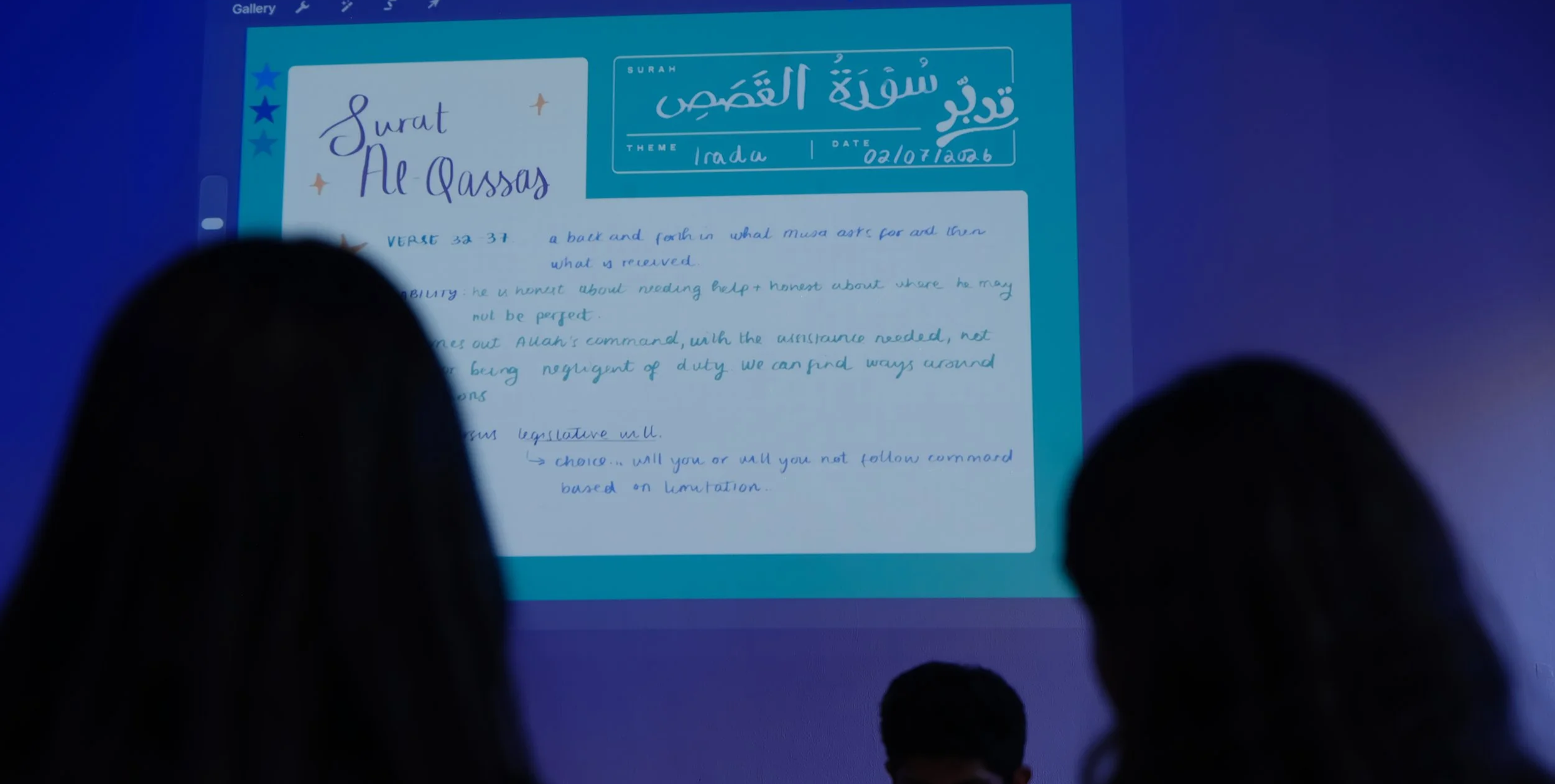
Ayahs 30-37 are further on in the life of the Prophet Musa (AS), showing him engaging directly with Allah after he was commanded to speak with the Pharaoh. After the Prophet’s (AS) supplication to Allah and openness about his anxieties, Allah addressed him both through divine miracles, and through allowing Musa (AS) to be accompanied by his brother.
فَلَمَّآ أَتَىٰهَا نُودِيَ مِن شَٰطِيِٕ ٱلۡوَادِ ٱلۡأَيۡمَنِ فِي ٱلۡبُقۡعَةِ ٱلۡمُبَٰرَكَةِ مِنَ ٱلشَّجَرَةِ أَن يَٰمُوسَىٰٓ إِنِّيٓ أَنَا ٱللَّهُ رَبُّ ٱلۡعَٰلَمِينَ
28:30: But when he reached it, a voice called out to him from the right-hand side of the valley, from a tree on the blessed ground: ‘Moses, I am God, the Lord of the Worlds.
وَأَنْ أَلْقِ عَصَاكَ ۖ فَلَمَّا رَءَاهَا تَهْتَزُّ كَأَنَّهَا جَآنٌّ وَلَّىٰ مُدْبِرًا وَلَمْ يُعَقِّبْ ۚ يَٰمُوسَىٰ أَقْبِلْ وَلَا تَخَفْ ۖ إِنَّكَ مِنَ الْآمِنِينَ
28:31: Throw down your staff.’ When he saw his staff moving like a snake, he fled in fear and would not return. Again [he was called]: ‘Moses! Draw near! Do not be afraid, for you are one of those who are safe.
Just as Musa (AS) continued to carry out Allah’s command and align himself with divine will (iradah), we reflected on the importance of not giving up nor becoming negligent due to fear of our insufficiencies. In the room, there was a commitment to keep turning to Allah and devoting ourselves to our duty in the face of our flaws. It is only then, in full submission, that we can find detachment from all outcomes, for we grow in understanding that He is always with us.
This surah is one example of the numerous ways in which Allah acted as Al Hadi, The Constant Guide, in the story of Musa (AS). It should only inspire us all to seek out the Ultimate Companion and Guardian, Al Hafiz, in our own stories too.
Members of our community will naturally continue to traverse turbulent periods of time, with both personal and political struggles weighing heavy on our hearts. In the face of these, may we submit to His plan so that He may fortify our hearts, for He is the best of planners, and Al-Wakeel, The Disposer Of Affairs.
Al Khaliq, The Creator, allow us to seek You in everything we do and every path we take.
Ya Al Waliyy, The Guardian, make us strong in our conviction and trust the story You have laid out for us.
Ya Al Jabbar, The Compeller, make us people who constantly surrender to Your divine will.
Ya Al Qahir, The Irresistible, just as Musa’s (AS) mother did, help us to be those who hear and obey without question.
Al Musawwir, The Fashioner, inspire us always and keep us inspired by You and You alone.
Al Nasir, The Helper, help us seek You in all stages and states of our life, in our helplessness and in the best of times, help us to make You our one and only constant.
Ameen
Authored by Anjum | Edited by Anas | Contributions from Aminah, Uzair & Hadeel | Photography by Anas
